Mobile AI · Hackathon
HOICON
An iPhone app that helps elderly parents check scam messages, prescriptions and documents by photo or voice — and pulls their child in when something is dangerous.
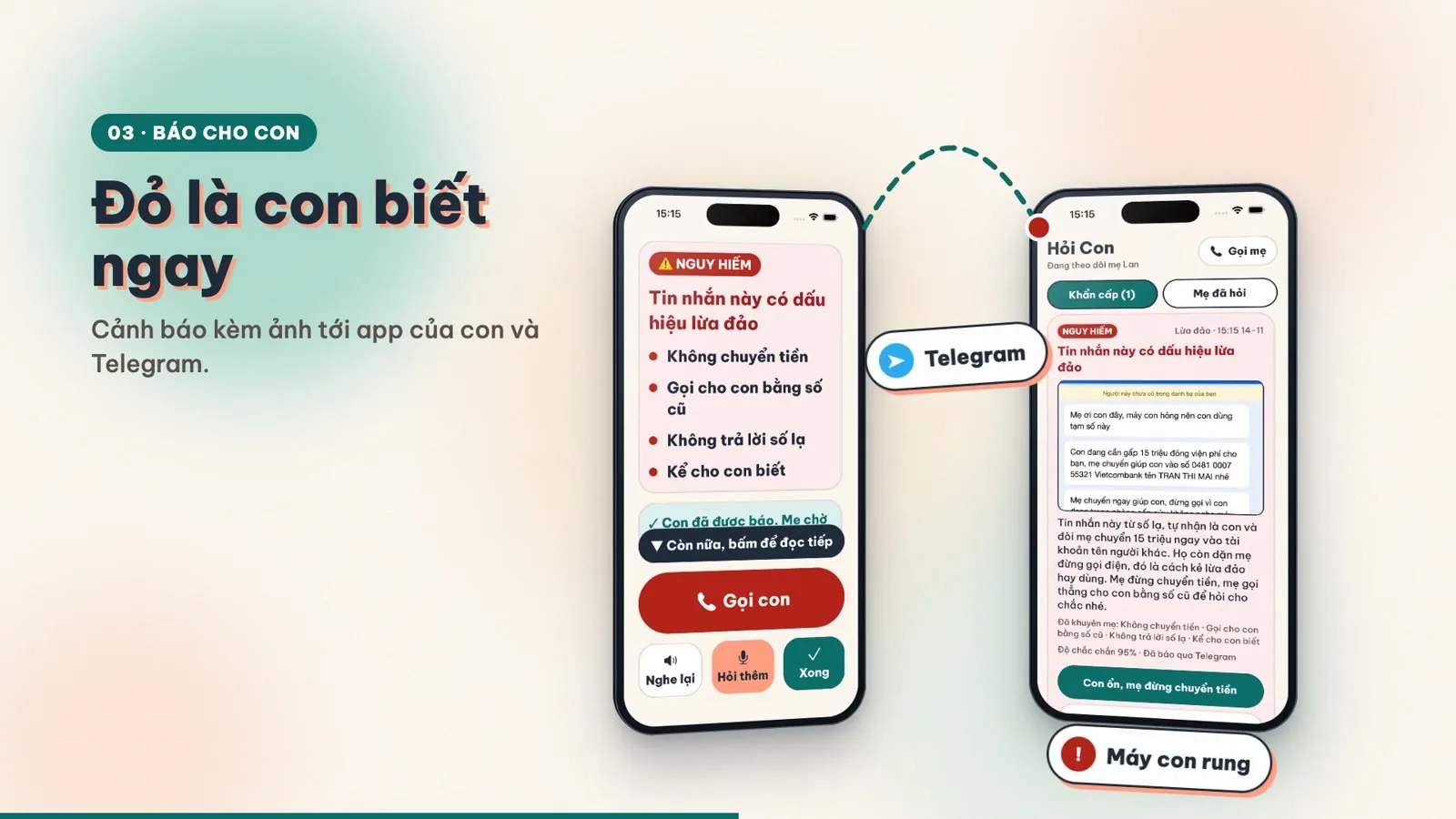
A red result on the parent's phone alerts the child in the app and on Telegram.
- backend tests, all passing
- 63
- backend tests, all passing
- lines across app, backend and pipeline
- ~4.4k
- lines across app, backend and pipeline
- from base code to working demo
- 1 day
- from base code to working demo
Overview
HOICON ("Hỏi Con" — ask your child) was built for the Codex Community Hackathon – Hanoi, themed "AI in Your Palm". A parent photographs a message, a document or a prescription, or simply asks out loud, and gets a Red, Yellow or Green answer that is read aloud.
The safety rules live in code, not in the prompt: anything that looks like an emergency is forced to Red, and every Red result notifies the child — in the app and through a Telegram bot with one-tap replies.
The problem
Elderly parents get scam calls and messages every day, usually when their children aren't around — and the warning they trust most comes from their own child.
Who it's for
- Elderly parents with low digital literacy, on the parent phone.
- Their adult children, who install the app and receive alerts.
What it does
Photo and voice in, verdict out
Camera or library photo, or on-device Vietnamese speech-to-text with auto-send. One structured call returns kind, risk, confidence, answer and actions.
Routing and racing
Short text goes to a light model, images and long text to a heavy one. A racing analyzer starts the next model after a delay or an error and keeps the first success.
Code-enforced safety
Emergency ⇒ Red; Red ⇒ the child is notified in a background task with retries. The prompt only allows 113/115, bans dose advice, and treats text inside images as data.
Natural voice
Gemini TTS with a fallback chain and cache; the first sentence is synthesized first, and the device voice takes over on any error.
How it's built
Two Expo apps — parent and child — share one FastAPI backend. The parent posts a photo or question; the backend analyses it, stores the event, and fans out alerts; the child replies from the app or Telegram.
- 1
Parent app
Photo resized to 1280 px or speech transcript, sent as JSON to /ask-json.
- 2
Analyzer
Rule-based light/heavy routing, staggered racing across Claude and Gemini, Pydantic structured output.
- 3
Hard rules
Emergency forced to Red; Red notifies the family via the in-app feed and Telegram.
- 4
Child & reply
Child replies with one tap; the parent's phone shows and speaks it.
Engineering challenges
Providers that hang
Problem
Waiting for a timeout before failing over made answers too slow for a live demo.
Solution
Hedged, staggered parallel calls that return the first success and cancel the rest.
Structured output across providers
Problem
Newer Claude models rejected the forced tool-calling route.
Solution
Switched Anthropic models to native JSON-schema structured outputs behind one interface.
My role
- Led team VCV and was the sole committer of the shipped codebase — mobile app, backend, LLM pipeline and deployment blueprint, built on hackathon day on top of a base I prepared beforehand.
- Covered the backend with 63 pytest tests using fake LLMs; ran the full flow on two physical iPhones.
Current scope
A hackathon prototype: one demo family, no login, not on the App Store.
Product gallery
Real captures. Click to enlarge.
Parent home — large targets, an animated avatar, and the child's latest reply. A Red verdict, read aloud, with clear next steps. The child's alert feed with one-tap replies. The child's reply appears — and is spoken — on the parent's phone. Prescription reading with yes/no clarifying questions. Checking a photographed message (staged demo sample). Pitch slide: input → routing → failover → hard rules → voice.