AI product · Full-stack platform
Talent Hub
A multi-tenant admissions and training-quality platform where AI screens applications with verifiable evidence — and humans make every decision.
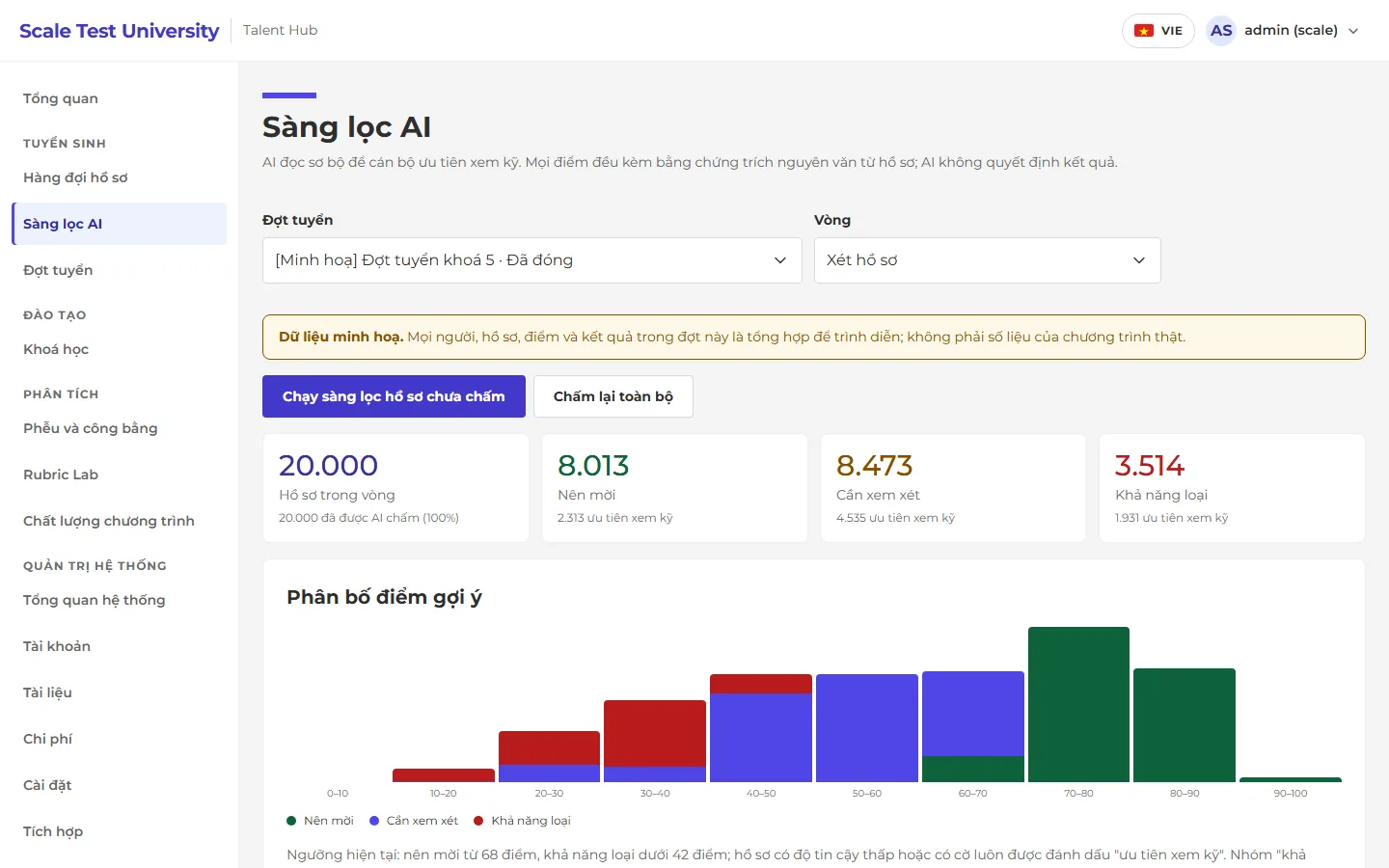
AI triage over 20,000 synthetic applications — suggestions only, never decisions.
- triage throughput on 20k synthetic applications (from ~95/s)
- ~2,000/s
- triage throughput on 20k synthetic applications (from ~95/s)
- Rubric Lab p95, measured locally
- 1.8 s → 49 ms
- Rubric Lab p95, measured locally
- backend tests, plus Vitest and Playwright suites
- 200+
- backend tests, plus Vitest and Playwright suites
- roles with scoped permissions
- 7
- roles with scoped permissions
Overview
Talent Hub covers the whole loop for programmes that run in cohorts: application intake, AI-assisted screening, review and approval, class and track placement, and finally whether learners reached the intended outcomes.
AI is used where it saves reviewers time — triage, duplicate detection, a cited assistant — but it never changes an application's status. Every decision goes through a state machine and a second person.
The problem
Programmes that pick a few hundred learners from thousands of applications rely on spreadsheets and CRMs: scoring is inconsistent and anchored, nobody knows whether the criteria predict success, and placement and outcome tracking are manual.
Who it's for
- Applicants, reviewers and approvers in an admissions round.
- Cohort and training managers, mentors, and IT admins — seven roles plus a platform admin.
What it does
Evidence-verified AI screening
Per-criterion scores with quotes from the application. Any quote that isn't found verbatim is dropped and confidence lowered. PII never reaches the model, and prompt-injection patterns are flagged.
Four-eyes decisions
A state machine with optimistic locking and an immutable timeline; the proposer can't approve their own decision, and quota checks take a row lock.
Tenant isolation in the database
Forced row-level security on every tenant table, a transaction-scoped org setting, a runtime role without bypass rights, and a test that fails if any table lacks a policy.
Cohort composer
Class, track and partner placement solved with the Hungarian algorithm on a preference matrix, with explanations and plan comparison.
Rubric Lab
Logistic regression, cross-validated AUC, bootstrap confidence intervals, re-weighting simulation and a fairness check — with explicit selection-bias caveats.
Cited assistant
Postgres full-text retrieval over programme documents; answers must cite sources and every number must appear in them, otherwise it abstains. Evaluated on a held-out question set.
How it's built
A Next.js BFF forwards a httpOnly session to FastAPI. Routers stay thin; services hold the business rules; analytics and the composer are pure functions. PostgreSQL enforces tenancy.
- 1
Next.js BFF
Per-request CSP nonce, org resolved from subdomain, API proxy with the session cookie.
- 2
FastAPI services
Workflow, decisions, triage, quality, integrations; RFC 9457 errors and an append-only audit log.
- 3
AI layer
Offline rule engine by default, optional LLM; evidence verification and cost caps per organisation.
- 4
PostgreSQL 16
One schema, organization_id + forced RLS, SET LOCAL per transaction, Alembic migrations.
Engineering challenges
AI that can't invent evidence
Problem
LLM screening output looks convincing even when the quote isn't in the application.
Solution
Model output is never trusted: each quote is located server-side and dropped if absent, and the assistant's citations and numbers are validated the same way.
Triage at 20,000 applications
Problem
The first bulk triage ran at about 95 applications per second.
Solution
A substring prefilter before regex, batched 500-row inserts and a spawn-based process pool brought it to about 2,000 per second on a laptop, with output verified identical row for row.
Two approvers, one seat
Problem
Concurrent approvals could overfill a quota.
Solution
Row locks around the quota check, proposer ≠ approver enforced in the service, and concurrency tests.
My role
- Wrote the requirement analysis and design docs, then built the backend, frontend, tests and CI as the sole developer — 21 merged pull requests.
- Developed in a short, intensive build with AI coding agents; I directed the design and reviewed and hardened the result through QA-driven fixes (open-redirect, proxy-header trust, mentor scoping, 422 handling).
Current scope
Runs locally with Docker; it is not deployed to the cloud. All data shown is synthetic.
The LLM screening path is tested against a fake client; the default engine is the offline rule engine.
Product gallery
Real captures. Click to enlarge.
Bulk AI triage: per-criterion scores, verbatim evidence and a suggested tier. Review queue with blind scoring — reviewers see AI scores only after submitting their own. Rubric Lab: which admission criteria actually predict outcomes, with confidence intervals. Programme quality: attainment by competency and track, data alerts and suggestions. Cited Q&A assistant — answers are checked against sources, or it abstains. Scoped integration keys for Power BI, LMS and CRM. Six-step applicant wizard on mobile, with autosave.